

Advice
Know what you’re buying before anyone quotes.
Short, plain guides to the parts of a boiler job that are hard to judge from the outside. Read them before you get quotes from anyone, including us.
Guide 1
Why a boiler stops in a cold snap
A modern boiler makes a small amount of waste water as it runs, and drains it away through a plastic pipe called the condensate pipe. If any of that pipe runs outside, a hard frost can freeze the water inside it. The boiler senses the blockage and shuts itself down.
The heating industry’s own trade body found that a large share of winter emergency calls turn out to be exactly this, not a failed boiler.
What to look for at home
- Find the plastic pipe coming out of the wall near your boiler.
- Industry guidance is that an outside run should be at least 32mm wide, insulated, as short as possible and sloping away from the boiler.
- If it is thin, bare or runs a long way outside, it is more likely to freeze.
If it has already frozen
Your boiler manufacturer publishes guidance on thawing a condensate pipe safely. If you’re not sure what you’re looking at, ring us on 07958 449008.
What we do
On the boilers we fit, we lag the condensate pipe where it passes through the wall, to help protect it against freezing.
Mild night. The water drains away outside and the boiler keeps running.
- The boiler. A modern boiler makes a small amount of waste water as it runs.
- Through the wall. The condensate pipe carries that water outside. We lag it where it passes through the wall, to help protect it against freezing.
- The outside run. The exposed stretch outside is where the water can freeze in a hard frost. A short, wide, insulated run that slopes away from the boiler is less likely to.
- Bends and the open end. Ice tends to block the pipe at a bend or where it opens over the drain. The boiler senses the blockage and shuts itself down.
Untreated. Left dirty and untreated, the water causes corrosion inside the system, and the rust settles as sludge.
Guide 2
Why the water in your heating matters
The same water goes round your radiators for years. Left dirty and untreated, it causes corrosion inside the system, and the rust settles as sludge. A new boiler connected to that water has to push it through its own parts.
This is also a warranty point. Manufacturer warranties usually depend on the system water being treated correctly and on a record that it was done. Damage caused by sludge may not be covered.
What to ask
- What will you do about the system water when the new boiler goes in?
- Will the treatment be written on my commissioning checklist?
What we do
When your boiler goes in, we treat the system with the correct chemical levels to help protect it.
Guide 3
The paperwork you should get with a new boiler
Once a boiler is on the wall, you can’t see whether it was set up properly. The paperwork is your proof that it was.
- Benchmark commissioning checklist. The installer’s record of how the boiler was set up and tested when it was fitted.
- Building Regulations certificate. Confirms the installation has been notified and meets the regulations.
Keep both with the boiler manual. If you had a boiler fitted and never received them, ask the installer who fitted it.
What we do
Every boiler customer of ours gets a completed Benchmark checklist and a Building Regulations certificate.
Guide 4
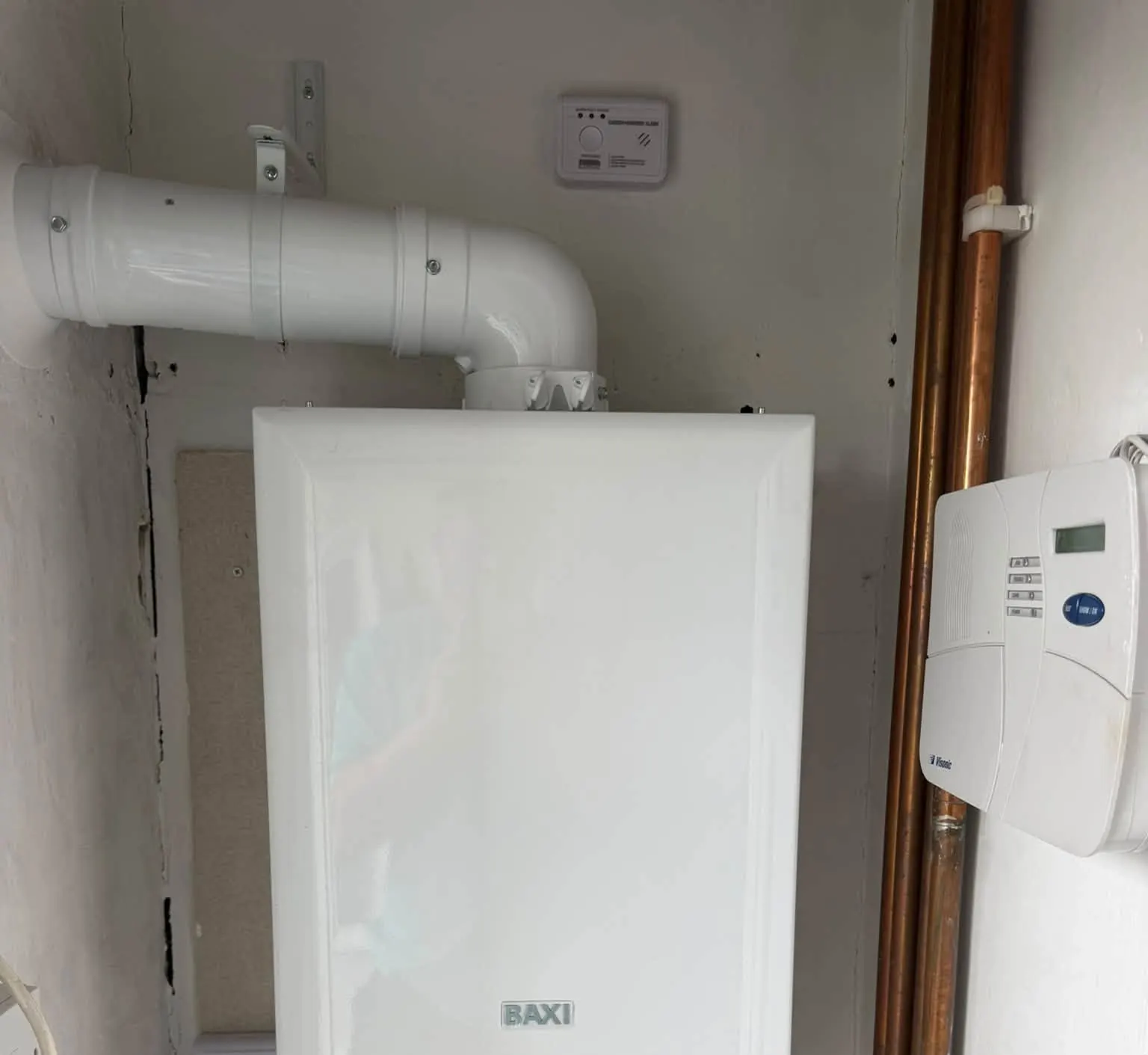
Carbon monoxide alarms and new boilers
Carbon monoxide is the gas an alarm near a boiler is there to detect. It is sometimes written as CO, and it is not the same thing as carbon dioxide (CO₂).
In Wales, since January 2025, a carbon monoxide alarm should be provided whenever a new or replacement boiler is installed. It is part of doing the job correctly, so nobody should be offering it to you as an extra.
What to ask
- Is a carbon monoxide alarm included with the installation?
What we do
We fit a carbon monoxide alarm with the boiler.
Guide 5
Old boilers and back boilers: what has changed
A back boiler sits behind the fire and sends a lot of its heat up the flue with the waste gases. A modern condensing boiler is efficient because it takes as much heat as it can out of those gases before they leave.
Moving from a back boiler or an older system to a modern boiler is called a conversion. It is a bigger job than a like-for-like swap, because the boiler usually moves and the pipework changes with it.
It is still legal to replace a gas boiler with a new gas boiler in an existing home.
What we do
We do like-for-like combi swaps and conversions from older systems. Tell us what you have now and we’ll come and look.
After. A modern condensing boiler is efficient because it takes as much heat as it can out of the waste gases before they leave. The boiler usually moves and the pipework changes with it.
Getting quotes? Take the checklist with you.
Eight questions to ask any boiler installer, why each one matters, and how we answer them.
Get your free quote
Tell us what you need and where you are. We’ll come and look, then send you a written quote, with no obligation.